It is common now for people to undertake stock trading online. Historically there have been American stock markets from the 1700s. In Philadelphia an exchange for trading currency was established to enable business owners to support their business and to grow the economy.
In the early 1800s, the New York Stock Exchange (NYSE) replaced the Philadelphia exchange. Initially New York Stock Exchange was a group of business people who met on a daily basis on Wall St to trade their stocks or bonds. This initial trading was all done outside until the Exchange moved indoors in the early 1900s. Whilst this traditional formuala served its purpose admirably, trading is no longer the bricks and mortar industry it once was. Trading no longer requires you to be in Wall St.The way the New York Stock Exchange works could be compared to an auction. If a company is listed on the stock exchange, they have a post in Wall St whereby trades are listed and a specialist is employed as an "auctioneer" to oversee the bidding on each trade. This form of trading keeps an accurate balance between supply and demand in the stock market so the price of the shares is kept in check.
These days, it is far easier to get involved in investing in stocks. In traditional stock trading, you engage a stock broker to take and place your order for you. You phone your broker to take the order and then there can be a delay in the order being executed. Now you no longer need to worry about using a stock broker to act on your behalf. If buying or selling stocks online you can place your order with the click of a mouse. Conveniently, trading this way is also a time saver. Setting up an account with a reputable, online brokerage company is easy. These online companies provide access to a wide range of services that were previously only available via a traditional bricks and mortar stock broking service. Setting up an online account gives you access to a variety of services including: up to the minute stock quotes, detailed historic performances of individual stocks, as well as detailed information about company fundamentals.One of the most common reasons investors like buying and selling stocks online compared with traditional brokerage is price. There are much lower brokerage fees for buying and selling stocks online than there are through buying and selling stocks at a traditional brokerage house.An important advantage of using an online brokerage service to trade stocks online is the significant price saving in brokerage fees. This is combined with the immediacy at which you can gather information required in making your stock purchasing decisions when trading online. Many investors also like the independence associated with trading shares online. Many traditional brokerage houses would try to influence your decisions when trading shares, but an online account means all the decisions you make are fully your own.
Online brokerage sites are not just about trading shares online. By giving you access to a wealth of information, online trading sites provide an important resource in formulating trading decisions. Many online brokerage sites will also provide courses designed to help you learn the tips and tricks of trading online. You can also get immediate access to your portfolio, instead of having to find all your stock certificates or calling your brokerage house.
Keeping pace with increases in technology has allowed the global economy to grow. The ability to buy and sell stocks online becomes a reflection of the economy adapting to meet the abilities of new technology head on. The ability of an investor to log in to their portfolio, no matter where they are in the world at that particular time, to trade shares online gives them the chance to take a greater role in securing their own financial future.
Most people who want to establish a financially-secure future choose to invest or trade in real estate. Indeed, if you take a look at the list of names of the wealthiest people in any category, most of them have allocated major portions of their assets in real estate. Donald Trump, who made his fortune in real estate is very popular and his success story is an inspiration to all of us.
Books like Rich Dad, Poor Dad , by Robert Kiyosaki and other property investing books written in the last fifteen years, introduced the average person to real estate investing. Thanks to these books, many people have opened their minds to new possibilities which they can now envision for themselves.
This article will not dispute the validity and the wisdom of investing in real estate. However, it might not be the best option for everybody. Each of us has different limitations and our circumstances vary. At the start -- for most of us -- we have to choose which area to specialise in since there is only so much money to go around. What I can do, is to at least highlight a few aspects of trading and investing in both areas. I then leave it to you to decide what you would like to focus on.
I should let you know that I have not yet invested in real estate myself, but I have considered it and I have asked myself the same questions you might be asking yourself now. I have read a lot on the subject matter and my assessment is purely based from my readings. Individuals using real-estate as their vehicle to create wealth may have different perspectives and I strongly advise you to seek their counsel to gain a more balanced outlook on this issue.
PASSIVE INCOME OR CAPITAL GAINS
If you like the idea of buying property to receive rent revenue, then the real estate market maybe better for you. You can structure your properties and contractual agreements to maximise the passive income you get from your tenants.
However, if you prefer to buy a property mainly because you think you can resell it at a higher price later, then you want to make money mainly from capital gains. If this is your philosophy, then forex could be a better trading vehicle for you than real estate because exchange rates fluctuate faster than real estate prices. Furthermore, transactions are easier and they are instantaneous to complete.
CAPITAL
To buy real estate, you need have at least 10% of the acquisition cost of the property, if your bank is willing to lend you the other 90%. If the house costs $350,000, you will need to cough up $35,000. That is a year's gross income for many people.
If you want to start trading forex, most brokers allow you to open a trading account for just $200. With $50, you can trade 10,000 units of a currency, if you have a margin ratio of 200:1.
LIQUIDITY
Whenever you want to buy or sell currencies, there is always someone willing to buy from - or sell to - you at the most competitive price. The forex market is the biggest market in the world and if you have hundreds of thousands of dollars you want to exchange for another currency, you can do so within a couple of seconds. To buy or sell a house or an apartment, you expect to wait for weeks, if not months.
PRODUCT HOMOGENEITY
In the real estate market, one house is not the same as another. Each property is unique. One might have a better foundation, a worse design or a prettier garden than another. Knowledge of these strengths and weaknesses become a significant factor if you are to make money from a transaction. Therefore, if you enjoy or if you are good at selling, promoting, negotiating and bargaining based on these differences, the real estate market is for you. Further, your lawyers, accountants, advisers, real estate agents and consultants play a significant role in your success.
If you want to trade currencies, there is no need to negotiate the price with the other party. If you are a seller, there is no need to educate potential buyers as to the benefits of your product. If you are buying, you have piece of mind that you are getting the best possible price for the currency from your broker at that particular point in time.
TRANSACTION COSTS
Buying and selling real estate is much more expensive than buying and selling currencies.
'SHORTING' MARKETS
When you have a property and you suspect that its price will go down in the future, your options are limited: hang on to the property or sell it now. In forex, if you suspect that a particular currency will depreciate in value, then you can exchange it for another currency. You buy it back again after it has already reduced in value to realise your gain.
MEDIATED TRANSACTIONS
In real estate you are dealing directly with the other party, taking on the other side of the transaction. This is why you need to go through a lot of paperwork and consult your lawyers to ensure that you know about the options available to you when the other party fails to fulfil his or her end of the bargain.
In forex, you do not have to worry about whether a buyer or a seller is going to fulfil his or her end of the bargain for whatever reason, because you are not directly dealing with that particular person. You are dealing with the broker who ensures that somebody will always take the other side of your trade.
CONVENIENCE
The forex market is open 24 hours a day. You do not have to meet the buyers or sellers in person. You do not have to conduct meetings with lawyers, accountant, bank representatives and so on. You can buy and sell currencies in your pyjamas at midnight if you like and the transaction will be complete before you go back to bed.
CONCLUSION
All in all, if you are an investor looking to make money from a combination of rent revenue and capital gains, you may want to invest in real estate for the long-term. If you are a trader wanting to profit purely on capital gains, then trading forex is probably better for you than trading real estate because you can start with a small fund and your rate of return is limited only by your ability to trade well. The transactions are mediated, it is more convenient and transaction costs are a lot smaller. The market is also more efficient due to product homogeneity and liquidity. Lastly, there are opportunities to profit regardless if the prices are going up or down.
I believe that if done right, neither venture is more or less riskier than the other. The risks are up to you to manage. With this article, I hope I helped you make a decision appropriate to your circumstances.
When you first start banking online, you may be offered free online bill pay. Online bill pay is a brilliant invention that saves you time and simplifies your budget, but only if you use it the right way. These tips can help you avoid surprise late fees and overdraft charges:
Set up reminders. Some banks let you send yourself reminders if you would rather not pay your bills automatically. Each month, you'll get a reminder to check on your latest bills and then pay them online. While this option is not automatic, you can check your balance to make sure you can cover the payment, and it takes less time than writing a check. Reminders come in handy for bills with changing values, such as the electric bill, and you can also use reminders to alert you when the money in your checking account dips below a certain level.
Make sure you know when the payment posts. Just because you make an online payment on a certain day doesn't mean the company or person you are paying will receive the money on that day. If you make the payment just before a deadline, but the payment posts afterward, you still missed the deadline, and you might be charged a fee. However, many online banks let you know when the payment will arrive, and you can schedule the date of the delivery. Give yourself a little extra time between when you schedule the payment and when the payment is due, and take weekends into account.
Find out if the money has been withdrawn. Since you aren't writing paper checks, you may fall out of the habit of balancing your checkbook. However, you need to make sure the transaction has cleared so you know how much you actually have. Some online bill pay services have features that let you balance your checkbook, but you can use good old paper and pen to track what you've paid out.
Learn about the bank's security practices. While online banking is secure, even more so than banking on paper, you still need to read about your bank's security standards before you sign up. Many sites offer details on their security standards. If your bank has a bricks-and-mortar branch near you, you can set up an appointment with a banker. Many of them have been briefed about online security and can tell you exactly what the bank is doing to keep your information safe.
Stay involved with your money. Even with online bill pay, it is your responsibility to keep your accounts balanced and find out if you have enough money to pay your bills; otherwise, you may wind up dealing with a late fee.
The advantages and disadvantages of online banking are both persuasive, and many people nowadays use a hybrid of both internet banking and a physical banking account with a local bank. While online banking doesn't seem as tangible as withdrawing and depositing your cold hard cash, you can do almost anything with online banking that you did at your bank branch.
Save Time and Money
Arguably one of the biggest advantages of online banking is saving time and money. When you use online banking, you can check your account, schedule bill payments and manage deposits with a few clicks of the mouse. Even better, you have control of your money 24/7; not on a 9-to-5 physical banking schedule at some place across town.
No more phone calls or trips to the ATM to check your balance; no more fussing around with paper bills, losing one and having to go search for it, and missing a payment; and no more wondering whether cousin Sally has cashed her birthday check, or waiting until your paper statement arrives in the mail to find out.
Online Bill Pay
Most internet banking institutions give you the option of setting up online bill pay. By using online bill pay, you can either choose to make a one-time payment on your bills, or you can set up recurring bill payments for monthly bills, such as an auto loan, car insurance or your mortgage. This advantage of online banking is invaluable since you can set up payments anytime and know exactly when the payment is credited.
No more putting a bill in the mail and receiving a notice the next month that the check arrived late, or that the recipient didn't get around to processing it until after your deadline. Online bill pay also saves you the worry of losing a bill; manage your bills electronically, and you never have to worry about a missing piece of paper.
Interest-Earning Accounts
It's common knowledge that online savings accounts typically earn a better interest rate than the savings accounts at a bricks-and-mortar bank, but you might not realize that some internet banking institutions also offer interest-earning checking accounts. Internet banking interest rates for checking accounts range from 0.5% to 3.40% annually. These rates rival the interest rate you'd get for a savings account at any traditional banking institution, and you're unlikely to find an interest-bearing checking account at a regular bank, either.
Funny Money
While internet banking makes it easier for you to manage your money, it might make it easier to forget to check how much you have so you can budget. Online banking is a lot like using a credit card-the easy access makes it easier to spend without thinking about why you are spending. You can set up e-mail alerts to let you know how when your account dips below a certain number, but nothing beats looking at it yourself and keeping your checkbook balanced.
Also, when you get a credit-card statement in the mail and open it on a monthly basis, you are instantly reminded to check if any strange charges appear on your account. It's easier to forget to keep track of such information online, and you'll need to have good money management habits.
Security
Hackers can break into nearly any computer system, so how can you be sure they won't break into your bank's system? You can't, but any online bank site you consider should have statements on the type of security they use. You should also e-mail the bank or head to the bank branch to find out exactly what would happen if there were a security breach and press the point or go to another bank if the answer is vague. In general, you should think of your money as being as safe online as it would be in a vault, but it is your responsibility to find out just how secure the bank is, if it is FDIC-insured and if they keep their security systems up-to-date. Finally, you should also make sure that you use security software on your personal computer to reduce the chance that anyone can get your personal data.
You Might Miss That Physical Location
While online banking has many advantages, one of the biggest disadvantages is the absence of a physical location. Being able to make deposits to a physical bank account assures peace of mind; you don't have to wonder if your check is lost in the mail or when it's going to be credited to your account.
You might also want that physical location for other reasons. Finances are complicated enough, and it's not a stretch to think that you might have a question about a transaction or fee someday. One of the disadvantages of online banking is that you can't speak to a customer service representative in person; you must either send an e-mail or call a number and wait for your call to be answered. If it's a sensitive question or if you are dealing with a mistake on your statement, you might get an answer faster if you go to a bank branch.
Internet Banking That Makes Sense: The Hybrid Approach
While an increasing number of companies have gone electronic, giving you the option of checking statements and paying online, some occasions even today simply require doing business on paper. Some companies aren't set up for online banking, so you'll need paper checks for those businesses. If you rent an apartment, your landlord probably isn't equipped to receive payments electronically, so you'll need a check to pay rent. While it's convenient to be able to use electronic bill pay, you're going to need to use a paper check at some point.
Deposits constitute another disadvantage of online banking. If you use a bank that doesn't have a physical location, you'll have to mail your deposits to your online bank. In these cases, you may be waiting a week or two for your deposit to be received and processed, and that's time in which you can't access that money. Sometimes things are lost in the mail, so the security of making a deposit by mail is questionable. Many people who use banks that exist solely online keep a second banking account at a nearby physical bank to make deposits and then transfer them electronically to their internet banking institution.
Even if you're inclined to rely solely on internet banking, the disadvantages of online banking are strong enough to make it prudent to keep a second banking account at a physical bank. Finding a physical bank that offers online banking provides the best of both worlds, giving you a location for fast and easy deposits, but the freedom to access your money anytime.
Set up computer barricades, choose a legitimate bank, keep passwords secret, check statements regularly and beware scam emails. These steps will help ensure happy surfing, shopping and banking.
Banking online tip 1: Barricades
Before even going online, install computer security. If your operating system came with a firewall, make sure it's activated. If not, install and activate a firewall. Keep it activated at all times. Install anti-virus and anti-spy software. There are several free and paid versions available. Whatever you choose, use the software regularly and keep it updated. Most software programs allow you to set run times as well as making updating an automatic process.
Banking online tip 2: Legitimate Banks
Most banks now offer banking online. Make sure you're doing business with an FDIC insured bank. Check for the FDIC logo or go to www.fdic.gov and see if your bank is on the list. When using bank services, there should be an extra 's' in the URL (example: https) letting you know the site is secure and encrypted. A locked padlock should be visible in the right hand corner of your screen. Click on the lock to view the type of encryption the site uses. If there is no padlock and no other visible sign of security, do not enter private passwords or other information.
Banking online tip 3: Protect Passwords
When creating personal identification numbers (PINs) and passwords, it's easy to use the same password everywhere. Some people even use the word password as their password. While these practices may be easy, they aren't safe. Nor are passwords containing family names, pet names, birthdays, anniversaries, telephone or address numbers. Such passwords are too easily hacked.
Create passwords from combinations of letters and numbers. Change your passwords regularly. If you are storing passwords, make sure the storage method is encrypted. When choosing security question answers, try to choose questions with answers that aren't readily known by other people.
Keep a password and banking information list with important papers inside a safe or deposit box. If something happens to you, someone may need the information to take care of business for you or to settle things in case of your death.
Banking online step 4: Check Statements Regularly
Keep an eye on bank and credit card statements and other financial mailings. If you find errors or suspect fraud, contact customer service immediately. Keep record of all communication with banks and financial services.
Be wary of unknown companies seeking your private information. When using credit or debit cards online, maintain the same safe practices that apply to banking. Make sure the site is secure before divulging information. Print ourt receipts for all online transactions. Check statements regularly and immediately report errors or possible fraud.
Banking online step 5: Beware Phishing (fishing) Emails
Never click on emails from unknown senders. Scam artists send emails that appear to be legitimate in an effort to steal your money and or identitiy. Banks, Credit Card Companies, Paypal and Ebay are often featured in fake emails.
Legitimate emails from your bank, credit card and other companies will not ask for personal information via email. They will not ask for passwords or account numbers in emails.
Never click on links inside emails from questionable sources. Scam artists imitate legitimate websites and steal your information when you log on to their phony sites.
Never download attachments from unknown sources. You could be opening your computer up to viruses, trojans and worse.
Banking Online Summary
Bill paying, shopping and banking online are convenient and save time and money. Before you log on, make sure you've activated barricades to protect your privacy and prevent fraud. Once online, make sure you're doing business with a legitimate bank. Use creative passwords and protect them. Check financial statements regularly and monitor for any sign of errors or potential fraud. Beware fake emails. Practice smart, safe banking online.Sound tips and strategies for online stock market trading are the key to success. Equally, avoiding pitfalls and traps is paramount to swinging the balance of winning trades in your favour. Ultimately, having successful strategies will minimize risk and in so doing lead to healthier online trading profits.
There can be a wide range of information sources to which you are exposed. Once people know you are involved in trading, it is very likely you will receive trading advice from all quarters, ranging from your distant relatives to your neighbour to the clerk at the local store. Nevertheless, some tips may be based on study, experience and expertise and yet this may not be apparent without further investigation or questioning. The point here is not to take offered information at face value but to conduct your own research to validate or discard the information.
Information overload is one pitfall which most traders face. Nevertheless, no matter how much research is used to guide your investment decision, stock market trading is about taking reasonable risks with no safety net. This is important to understand. It is about using the information resources to minizing risk and then taking the plunge. Seeking absolute certainty should not be a factor.
There are likely to be changing trends in the popularity of various information resources used for gathering stock trading tips. This is human nature. Allow enough time to properly evaluate the worth of your tips resource rather than acting impulsively and at the same time retain a watchful eye for any change in consistency or reliability.
Free information can be very useful to guide initial research. However it may also lack the depth required to make robust decisions which effecively minimize risk. Be prepared to cut your free information resource if it fails to be valuable in arriving at decisions on which you can take action.
Software to analyze stocks and patterns of trading can be very useful to save valuable time in arriving at buy and sell decisions. If however the software cannot be customized to provide recommendations which match your own trading strategy then it is a waste of your valuable time.
Adopt consistency in the application of your online trading strategy. Your chosen methodology should fit any tips you consider, not the other way around. Tips will come and go. It is unwise to change your strategy to fit the latest tip.
Finally, be aware of the various strategies and pitfalls when considering trading tips. Take the time to evaluate your information sources. Be true to your trading strategy and use tools which support your methodology.
Todays current futures market is quite unlike the futures of the 19th century. Todays future market is a worldwide one that includes manufactured goods, financial currencies and treasury bonds, and agricultural products.
When you speculate on futures it is not the actual good that is speculated upon rather it is the contract for the goods that is traded as value. Every futures contract includes a buyer and a seller. The following is an example of a futures speculation: A farmer agrees to deliver 1000 bushels of corn to a baker at a price of $5.00 a bushel. If the daily price of corn futures falls to $4.00 a bushel, the farmer's account is credited with $1000 ($5.00 — $4.00 X 1000 bushels) and the baker's account is debited by the same amount. Futures accounts are settled every day.
Using the above as an example this is how the contract settlement would play out: If the price of corn futures is still at $4.00 the farmer will have made $1000 on the futures contract and the baker will have lost an equal amount. However, the baker can now purchase corn on the open market at $4.00 a bushel — $1000 less than the original contract, so the amount he lost on the futures contract is made up by the cheaper cost of corn. Also, the farmer must sell his corn on the open market for $4.00 a bushel, less than what he anticipated when entering the futures contract, but the profit generated by the futures contract makes up the difference.
Speculators profit by daily fluctuations in the futures market by choosing to buy from the seller (buying short) or from the buyer (buying long).
The FOREX market has advantages over the futures market. FOREX is the largest financial market in the world. It is a liquid market and stop orders can be executed more easily and with less slippage than in other markets. The FOREX market is open 5 days a week, 24 hours a day. Traders can take advantages of opportunities as they become available. FOREX transactions are usually instantly executed. FOREX transactions are commission free. Brokers earn money on the spread.
Some investors feel that due to built in safeguards that FOREX trading is safer than futures trading.
Courage Under Stressful Conditions When the Outcome is Uncertain
All the foreign exchange trading knowledge in the world is not going to help, unless you have the nerve to buy and sell currencies and put your money at risk. As with the lottery “You gotta be in it to win it”. Trust me when I say that the simple task of hitting the buy or sell key is extremely difficult to do when your own real money is put at risk.
You will feel anxiety, even fear. Here lies the moment of truth. Do you have the courage to be afraid and act anyway? When a fireman runs into a burning building I assume he is afraid but he does it anyway and achieves the desired result. Unless you can overcome or accept your fear and do it anyway, you will not be a successful trader.
However, once you learn to control your fear, it gets easier and easier and in time there is no fear. The opposite reaction can become an issue – you’re overconfident and not focused enough on the risk you're taking.
Both the inability to initiate a trade, or close a losing trade can create serious psychological issues for a trader going forward. By calling attention to these potential stumbling blocks beforehand, you can properly prepare prior to your first real trade and develop good trading habits from day one.
Start by analyzing yourself. Are you the type of person that can control their emotions and flawlessly execute trades, oftentimes under extremely stressful conditions? Are you the type of person who’s overconfident and prone to take more risk than they should? Before your first real trade you need to look inside yourself and get the answers. We can correct any deficiencies before they result in paralysis (not pulling the trigger) or a huge loss (overconfidence). A huge loss can prematurely end your trading career, or prolong your success until you can raise additional capital.
The difficulty doesn’t end with “pulling the trigger”. In fact what comes next is equally or perhaps more difficult. Once you are in the trade the next hurdle is staying in the trade. When trading foreign exchange you exit the trade as soon as possible after entry when it is not working. Most people who have been successful in non-trading ventures find this concept difficult to implement.
For example, real estate tycoons make their fortune riding out the bad times and selling during the boom periods. The problem with trying to adapt a 'hold on until it comes back' strategy in foreign exchange is that most of the time the currencies are in long-term persistent, directional trends and your equity will be wiped out before the currency comes back.
The other side of the coin is staying in a trade that is working. The most common pitfall is closing out a winning position without a valid reason. Once again, fear is the culprit. Your subconscious demons will be scaring you non-stop with questions like “what if news comes out and you wind up with a loss”. The reality is if news comes out in a currency that is going up, the news has a higher probability of being positive than negative (more on why that is so in a later article).
So your fear is just a baseless annoyance. Don’t try and fight the fear. Accept it. Have a laugh about it and then move on to the task at hand, which is determining an exit strategy based on actual price movement. As Garth says in Waynesworld “Live in the now man”. Worrying about what could be is irrational. Studying your chart and determining an objective exit point is reality based and rational.
Another common pitfall is closing a winning position because you are bored with it; its not moving. In Football, after a star running back breaks free for a 50-yard gain, he comes out of the game temporarily for a breather. When he reenters the game he is a serious threat to gain more yards – this is indisputable. So when your position takes a breather after a winning move, the next likely event is further gains – so why close it?
If you can be courageous under fire and strategically patient, foreign exchange trading may be for you. If you’re a natural gunslinger and reckless you will need to tone your act down a notch or two and we can help you make the necessary adjustments. If putting your money at risk makes you a nervous wreck its because you lack the knowledge base to be confident in your decision making.
Patience to Gain Knowledge through Study and Focus
Many new traders believe all you need to profitably trade foreign currencies are charts, technical indicators and a small bankroll. Most of them blow up (lose all their money) within a few weeks or months; some are initially successful and it takes as long as a year before they blow up. A tiny minority with good money management skills, patience, and a market niche go on to be successful traders. Armed with charts, technical indicators, and a small bankroll, the chance of succeeding is probably 500 to 1.
To increase your chances of success to near certainty requires knowledge; acquiring knowledge takes hard work, study, dedication and focus. Compile your knowledge base without taking any shortcuts, thereby assuring a solid foundation to build upon.
Most investors who trade Forex stocks use a broker. A broker is an individual or a company, who buys and sells stocks according to the investor's wishes. Brokers earn money by collecting commissions or fees for their services.
You should check that a broker is registered as a Futures Commission Merchant (FCM) with the Commodity Futures Trading Commission (CFTC) as protection against fraud or abusive trade practices. A Forex broker also needs to be associated with a financial institution, such as a bank in order to provide funds for margin trading. Picking the right Forex broker for you will take some work on your part. There are brokers who charge a flat fee and some that charge commission. It may be a good idea to talk with friends and business associates about their brokers. You may get some good leads, and you're certain to hear who to stay away from. There is nothing like word of mouth advertising.
If you are thinking of investing online, you could choose several online brokers and contact their help desks. Seeing how quickly they respond to your questions could be key in how they will respond to their customers needs. If you don't get a speedy reply and a satisfactory answer to your question you certainly wouldn't want to trust them with your business. Just be aware that as in other types of businesses, pre sales service might be better than after sales service.
Before you choose an online broker get a copy of their online demo account. What features are included? Is the software reliable? Does it offer automatic trading? Are there extra software features that cost more?
Before setting up an account with a Forex broker you will need to do further investigation. How quickly will these brokers execute your buy/sell orders? What is their policy on slippage? What are the transaction fees? What is the spread, fixed or variable? What are the margin requirements and how are they calculated? Does the margin change with currency traded? Is it the same for mini accounts and standard accounts?
Don't forget to ask about minimum account balances and interest payments on account balances. Make sure that your funds will be insured.
Investors and traders can trade currencies worldwide, in any trading zone, 24 hours a day, in today's foreign exchange market. London, Japan and New York top the top three currency traders among the currency dealers. These currencies are being traded 24 hours a day. The only time that currencies stop trading is on Friday when the Japanese market shuts its doors. There is a one day window after Japan closes before Europe steps in on Monday morning to open for business.
The majority of trading comes from banks, brokerages and investment companies. Companies that sell and buy foreign currencies as part of their business, like independent brokers and currency dealers, make up only a small part of the foreign exchange currency trading. The Forex market will continue to develop and grow at a steady pace as more currency traders become aware of the foreign exchange markets potential for earning and raising capital. The Forex market reaches an average daily turnover 30 times higher than any other U.S. market.
Added to the drive for supply and demand, the Forex market presses on as the enormous scope for profit potential among the currency dealers is steadily rising. The Forex market also uses the free floating system that is considered more practical for today's foreign exchange market which can experience a change in the currency rates at an estimated 4.8 seconds. The Forex market is taking on a prodigious role in the country's economy, after developing from connective financial centers to one unified market. Having expanded worldwide, the Forex market is reflecting the constant growth of all international trades and their countries. When you consider the size of the foreign exchange market, it would be important to understand that any transactions that are made with a future trading broker or an independent broker, can lead to more transactions. This can be due to the brokerage businesses as they work to readjust their positions.
Understanding your overall portfolio and its sensitivity to market unpredictability is necessary in order to be an effective day trader. This is especially important when trading foreign exchange currencies, because these currencies are priced in pairs and no single pair will trade completely independently of the others. Gaining an understanding of these correlations and how they can change will help you use them to your advantage to control your portfolio's exposure.
Correlations Defined
There is a reason for the interdependence of foreign currency pairs. For instance, if you were trading the British pound (GBP) against the Japanese yen (JPY) or GBP/JPY pair, then you're trading a type of derivative of the USD/JPY and GBP/USD pairs. Therefore, the GBP/JPY must be slightly correlated to one or both of the other currency pairs. Even so, the interdependence amongst these currencies will stem from more than the fact that they are in pairs. While there are some currencies that will move one right behind the other, the other currency pairs can move in different directions often resulting in a more complex force. In the financial world, correlation is the statistical measure of a relationship between two securities.
Then there is the correlation coefficient that ranges between -1 and +1. The correlation of +1 indicates that two currency pairs can move in the same direction nearly 100% of the time. While the correlations of -1 indicates that two currency pairs are likely to move in the opposite direction 100% of the time. If the correlation is zero, this indicates that the relationships between the currency pairs will be completely at random.
Correlations are not always stable. Correlations change, just as the global economic system and other various factors can change on a daily basis, making the ability to follow the shift in correlations very important. The correlations of today may not be in line with the long-term correlations between any two-currency pairs. This is why it's suggested to take a look at the past six months trailing correlation to provide a more clear perspective on the average relationship between the two currency pairs. This change is the result of a variety of reasons — the most common reasons being a currency pair's predisposition to commodity prices, the diverging monetary policies and unique political and economic circumstances.
A slump in the dollar this morning seems largely confined to a gain for the single European unit. The British pound has nevertheless made gains against the greenback despite a further sign of impending slowdown. Few dealers appear to want to be the first to prod the Bank of Japan into a second wave of intervention. According to further analysis in the aftermath of Wednesday’s initial round of yen sales, the central bank sold far more yen than was initially realized at the time.

U.S. Dollar – There appears to be no obvious catalyst to a 0.4% slide in the value of the dollar index at present. Gold and the euro have both surged at the same time while the response across other majors is muted. There are two relatively data points due for release on Thursday starting with initial unemployment insurance claims. The predicted decline of 4,000 to 451,000 would actually be good news for the dollar. Later in the morning the Philly Fed manufacturing index is forecast to depict a slower pace of factory activity in the region.
Euro – The euro’s surge is something of a mystery at this point in time. It had a positive tone over several hours in the European session and by 7am in Manhattan kicked the dollar out of bed forcing it to $1.3109. That’s the highest the euro has been since August 11. The Eurozone earlier reported that the trade surplus grew last month as imports dropped at a faster pace than did exports.
Japanese yen – The Bank of Japan reported a surge in deposits held by financial institutions by enough to suggest that midweek currency sales totaled ¥2 trillion ($23.4 billion). Banks likely hit by sales at the central bank were today talking larger numbers than yesterday’s initial suggestion of a couple of hundred billion yen. The larger volume of yen sales seems to have nurtured a new found respect for the Bank of Japan as the clinical and well-timed nature of its actions appears to have achieved a goal. The precise nature of the goal, however, remains unclear. Is the central bank trying to guide the yen lower or is it trying to stop its ascent? Investors did attempt to force the yen higher overnight when it reached ¥85.25. Dealers suspect that opportunist exporters were trying to repatriate yen at its weakest in several weeks ahead of the forthcoming end of the first half of the fiscal year. The yen has subsequently weakened to ¥85.70 per dollar while per euro the yen eased to ¥112.05.
British pound – Although the pound remains lower at $1.5611, a failing dollar is masking the performance of the British unit. A horrible retail sales report for August earlier sent the pound briefly to a session low of $1.5538 on deepening worries that the economy is unlikely to be able to stave off a further slowdown. Simply put, weakness in consumption was not expected at this stage of the game. A monthly drop of 0.5% in sales since July was compounded by an ugly downwards revision to the previous month’s data. The result is that the predicted annualized pace of gains in retail sales turned out to be a mere 0.4% rather than the 1.9% expected. I suspect that if the dollar was not nursing a bruise on the head this morning that the pound would be in far worse shape. The pound did lose out to a resurgent euro, which today buys 83.82 pence.
Aussie dollar – Just to prove that the U.S. dollar’s weakness doesn’t appear associated with a risk rally the Aussie remains lower overnight. And that was despite reports of a bullish tone to words from the RBA’s Assistant Governor Philip Lowe who said that the economy was growing at close to full speed and that would help continue to push the rate of unemployment back to full employment. The Aussie nevertheless slipped and is trading at 93.67 U.S. cents and remains weaker against the yen where it buys ¥80.23.
Canadian dollar – The Canadian dollar remains range bound and has barely budged against the U.S. unit where it currently buys 97.27 U.S. cents. Dealers were unnerved yesterday following a weaker than hoped for manufacturing report indicating export market weakness TOKYO (MNI) – In his parliamentary testimony this week, Bank of
Japan Governor Masaaki Shirakawa repeated his recent remarks that the
yen’s strength will benefit firms and households in the long term by
boosting Japan’s terms of trade but the BOJ will watch the short-term
drag from the rapid rise in the yen on exporter profits.
He also told the lower house financial affairs committee on
Wednesday that global investor risk aversion had pushed up the value of
the swiss franc, the yen and the U.S. dollar in that order in forex
trade in the past month while the loss in the euro had been the largest
among major currencies.
“The flight to safety basically comes from the recent weak U.S. and
other economic data in the summer, raising concerns about downside risks
to the global economy,” Shirakawa said, adding that the euro was hit by
heightened concern about the health of European banks.
“For the Bank of Japan, whatever the results (of investor risk
aversion), we are fully aware that a rapid rise in the yen will hurt
business sentiment,” the governor said.
The high yen would prompt firms to move production bases overseas
in order to maintain their price competitiveness but at the same time it
would encourage Japanese firms to buy overseas assets that would help
boost their global operations, he said.
In his own parliamentary testimony this week, Finance Minister
Yoshihiko Noda repeated that the government will take a firm action on
excessive forex moves, “with currency intervention in mind,” while
keeping in close contact with other major nations. He also said the MOF
was conducting various “simulations” on foreign exchange intervention.
Shirakawa repeated his remarks from the latest news conferences
held after the policy board meetings on Aug. 30 and on Tuesday that the
BOJ is more concerned about downside risks to a sustained economic
growth than upside risks.
He added that the threat of the strong yen comprises a large part
in the current downside risks to Japan.
“I said after the Aug. 30 meeting that if necessary, we will take
policy action in a timely and appropriate manner. That’s partly because
I thought if we didn’t make our stance clear to markets, the recent
moves could be accelerated,” he said.
To send a clearer message, the BOJ on Tuesday added to the monetary
policy statement its resolve to “carefully examine the outlook for
economic activity and prices, and, if judged necessary, take policy
actions in a timely and appropriate manner.”
Shirakawa also told lawmakers that interests on 3- and 6-month term
facilities had fallen slightly since the Aug. 30 credit easing, which
shows that the expanded lending to banks for 3- to 6-month cash needs at
a bargain overnight rate (0.1%) is already boosting the effects of the
BOJ’s extremely accommodative monetary policy.
Financial crises are always caused by funding problems, both at
government and corporate levels, but Japan is a top creditor nation,
with its net asset holdings accounting for 50% of its GDP, making it the
strongest among industrialized economies, he said.
This, combined with market confidence in Japan’s macro-economic
policy toward sustained growth with price stability, is prompting a
flight-to-quality move in the forex market, Shirakawa said, explaining
the recent rise in the yen against the dollar and the euro.
Being a forex day trader can be very lucrative. The currency market is by far the most liquid and volatile market in the world and with this come various opportunities. No matter what type of market you chose to day trade you must know the “personality” of the market you are trading.
Every market has it’s own characteristics and it is important to know what they are before attempting to profit from it. The forex market is no different. In this article we will go over very important general day trading principles/rules and then we will see what a day trader has to recognize when specifically day trading the forex market.
As the term implies, day traders are concerned with what happens in the market today. Not tomorrow, not next week and not next month, but today. The day trader’s job is to capture intraday price swings. Depending on the system or trading method employed, this can mean capturing one intraday swing or various intraday swings. The general job of a day trader is (then we will go over the more specific job of the forex day trader):
To control risk
One of the most important jobs as a day trader is to control your risk exposure. Sure, controlling risk is a concept you must use in any type of trading, however in day trading you must look at this issue from a different angle. Since your job is to capture various price swings during the day naturally your profit objectives will be much smaller than that of a swing trader (who places a single trade aiming for a much larger profit objective). So, when placing several trades during the day it can be easy to “drift” away from your pre-determined stop loses. A common (very common actually!) day traders thought is “if I extend my stop loss just a bit I hope the market will turn around”! Hope is one of the trader’s biggest enemies. These little extensions of stop losses add up and suddenly without noticing you are losing more dollars per trade than planed making your risk/reward ratio turn against you.
To be disciplined
This principle is key for any type of trading but particularly for day trading. If I had to name one single aspect of a day trader that can make him or her a winner or a loser it is discipline. You can have a so-so system but still make money if you are disciplined. However, you can have the best trading system in the world but if you are not disciplined I guarantee you will not be a successful trader. So, what is all this discipline everyone talks about when discussing trading? Very simple, it’s respecting and strictly following your trading plan, your trading system, your money management rules, and your commitment to the business. Being disciplined with regard to each and everyone of these components is essential for your success.
It is so easy to deviate from your trading plan, the rules of your trading system or any of the above mentioned components, especially when day trading. Why? Two reasons. First, because the trader is trading very frequent and does not have time to cool down, think, and evaluate. Second, because reality is replaced by hope. Your trading system rules (reality) says: “get our of the trade” hope says “hang in there, maybe it will still be profitable”. Your money management rules (reality) say “risk only 2% of your account on this trade” hope says “since I lost on the last trade I will risk 4% on this next one so I can make up for the loser and also be profitable”. Your trading plan (reality) says “trade each day 4 hours, give yourself Wednesday or Thursday a vacation to rest” hope says “Since I am not doing very well now I don’t need this rest day, and I will also trade 7 hours per day to make up”. I know (not hope!) you now understand the point!
To focus on the appropriate time frame
As a day trader your primary concern is to catch intraday swings. Your trades start and finish the same day. Your world is the day you are trading in. You don’t care what will happen in the market tomorrow or the day after tomorrow. Your objective when trading is focusing on the appropriate time frame chart. My opinion is that day trading should be done on a 1, 5 or 10 minute bar chart. Remember, you are looking to capture several fast moves during the day and hence you must focus on the charts that best illustrate events as they happen in a short period of time. However, the fact that you are day trading on a 1,5 or 10 minute bar chart does not mean you can’t use a larger time frame chart for the purpose of analysis. This however, is very subjective and depends very much on the traders strategies and methods of trading. As an example, many day traders would look at one hour bar charts in order to have a view of how the market has been behaving in the last week. Is it moving sideways (and so maybe I should only place trades between support and resistance areas)? Is it trending (and so maybe I should only be looking at placing trades in the direction of the higher time frame trend)? Are there any major support and/or resistance levels I should be aware of (areas where I should refrain from placing trades since it is uncertain how the market will react when reaching them)? Did the market brake out of a congestion area?
Again, it is very subjective. Some day traders believe that with proper larger time frame analysis they can select better day trades. My personal opinion is that the more you analyze the more conflicts you will have and the more uncertainties will appear (especially if you are new to trading). I like making things simple and I found it very useful when trading (proof of this is that all of the trading systems I use are 100% mechanical). Don’t get me wrong, this is not to say that larger time frames should not be used at all for analysis purposes. But, try to keep it simple and if you see that looking at larger time frame charts interferes with your correct decision process when placing day trades then simply stop.
To trade volatile and liquid markets
Since your job as a day trader is to capture intraday swings it is crucial that the market you are trading has enough movement to allow you to do this. It is also important that the market you are trading has enough liquidity so that order fills do not suffer from excessive slippage. You have to select a market that it’s volatility is permanent and not a temporary occurrence. Since you are basing your trading method on catching intraday price swings you have to know that you are trading in the right place. As a day trader volatility is your allay and you have to know that you can count on it every single day (or at least 90% of the days). Liquid markets will provide you with good order fills. As a day trader this is very important since you are aiming at smaller profit objectives and hence larger slippage will eat away more of your profits. When trading several times a day this adds up and can be the difference between success and failure.
As a forex day trader you have to apply all the above rules and principles plus other criteria that are unique to the forexmarket.
Time of day trading
The forex market is a 24 hour market. Never stops except on weekends. Within this 24 hour period different currencies behave in different manners. As a day trader it is very important to know the “personality” of the currency you are trading. For example, the GBP/USD is more volatile in early to mid European session than any other liquid pair. For a day trader trading in these hours it would be wise to take advantage of the price swings the GBP/USD pair offers instead of trading some other currency pair that constantly shows no movement. The USD/CAD pair is “silent” in the early to mid European session but starts to have more price movement toward the start of the US session. Every time Non Farm Payroll is released most if not all currency pair have a very small price range up to release time. As a day trader it wouldn’t be wise to trade during these pre-announcement hours with strategies that are based on breakouts. It would probably be smarter to use strategies that are based on range support and resistance.
Spread and liquidity
| Forex brokers don’t charge you a commission for every trade you make (at least most forex brokers). Instead, they make their profit on the bid/ask spread which is measured in pips. As a forex day trader you are aiming at capturing small price swings sometimes several time per day. Also, your profit objectives are obviously much smaller than the swing trader’s profit objectives. All this means one thing: every pip counts. You cannot afford to trade currency pairs with large spreads, if you do your profit will get eaten up to a point where you will not be trading with an adequate risk/reward ratio. Forex day trading must be done with liquid pairs. |
|
Most forex brokers will provide you with a very narrow spread for the most liquid currency pairs. As an example, many brokers are now offering a 2 pip spread for EUR/USD and USD/JPY and a 3 pip spread for USD/CHF and GBP/USD. These are the most liquid pairs and the ones a day trader should focus on.
Volatility
As a day trader volatility is you friend, a friend you cannot afford to trade without. In it’s basic definition, volatility is simply the amount of price change with relation to time. Volatile currency pairs have various price swings (price changes) during a small period of time (one day). These price swings are what a day trader lives on. In the forex market volatility many times comes hand in hand with liquidity. The most liquid pairs are the ones that are the most volatile. The big 4: EUR/USD, GBP/USD, USD/JPY and USD/CHF are the most liquid pairs that provide the best volatility and hence opportunity for the forex day trader. Within these four pairs, the GBP/USD is the most volatile. Although it’s not the most liquid (the EUR/USD is), but it’s the most volatility. This pair, traded with the right broker (one that provides a 3 pip spread) can present many profitable opportunities for the astute day trader.
Specific news announcements
Currency rates are affected by rumors, news, economic indicators and government reports. As a day trader you must always be aware of what economic reports are scheduled on the day you are trading and at what time. Why? Simply because many of these reports can have a strong momentary impact on the market once they hit the news wires. This impact can be of 10 pips or 100 pips depending on the report and it’s difference from the market consensus. The most important and impacting economic indicators and government reports are issued by the US government. They affect every USD/X or X/USD currency pair. Again, always know what are the release times and the importance of the economic report. For example, suppose you are in a EUR/USD trade at 8:25 a.m. You know that an economic report is scheduled for release at 8:30 a.m. You might consider either exiting the trade before the release (in order to avoid unnecessary speculation as to what impact the report will have on the market) or entering your profit objective and stop loss into your deal station (for risk exposure reasons).
In conclusion, the forex day trader has to be prepared not only with the basic day trading rules, skills and principles. His job is to incorporate into his trading the characteristics and uniqueness of the forex market. Remember, every currency pair might present different opportunities and it is your job to always focus on the ones that best fit the purpose and objectives of day trading. I hope to have contributed to your forex trading education and I thank you for taking the time to read this article.
A trading strategy is a systematic, step-by-step, approach to trading. Using a forex system to trade is of utmost importance to the long-term success of a forex trader. A forex trading system or strategy will equip a new trader with a set of steps to follow; a set of steps that will build discipline and self confidence in the trader. There are many traders in the forex market that don't have a set of strategies and simply go by "gut feel." This can be dangerous because the trader will eventually fall prey to one of his greatest enemies - his emotions. As part of our forex training program, we teach our traders to apply different trading strategies. The goal of Forex Trading USA is to educate traders to rely less on their fear and greed and more on a disciplined trading approach. The strategies tought will include:
Which currencies to use
No amount of technical analysis in the world can save a trader from a lack of direction. Having a forex system to trade provides the guidance a trader needs to succeed. In our forex trading training the establishment of a specific forex strategy is a primary goal. Generalities don't work in the forex market, so we don't want to fill traders with useless information. We want to create knowledgeable and powerful traders.
What's reassuring at the beginning of this week is the fact that stocks of the United States started to rebound while the investors currently envisage a precipitated passage of the economic invoice of stimulus in the senate. The analysts started to provide that this package of stimulus would obtain last rather quickly because of the poor data of employment published Friday. With such a negative news in the sector of work, the government of the United States will have to undoubtedly take fast measures to avoid this recent turning of the events while it seems to develop in spirals out of the order. But this stimulus will be asse' with stave with to far promote losses in the dollar of the United States?
Insofar as the news goes this week, USD are not placed to receive much information concerning the economic releases. However, because this week can mark the passage of President Barack Obama's economic package of stimulus tradesmen of forex will see a gust of wind of the speeches and press conferences held by high members of the administration the future of the economy, between other matters. The information published of this fa4con can sometimes carry indices subtle as for the future of the other potential legislation of stimulus as well as of the monetary policies and tax. If the bill is indeed voted this Tuesday, as many economists envisage, it can carry the impact of the request for amplification of the goods and the services of the United States, which will increase in the same way the request for USD. The tradesmen could look with an appreciation of the dollar against the majority of its pairs of currency this week.
There were a few other non-financial reasons for opening the account. First, there’s no marginal cost to opening another savings account. HSBC has a well known international name and has consistently been among the leaders in interest rates. I would be hesitant to open an account at a lesser known bank. HSBC’s international presence is also a benefit. When we were in China and Taiwan, HSBC was everywhere (along with Citigroup) and that’s a side benefit. Lastly, my mom has an HSBC account, in part because of the China and Taiwan presence, and having that link is convenient as well.
Opening An HSBC Account
The HSBC account opening process is quick and painless (~10 minutes), though it requires more information than most banks because they try to set up everything in one pass. You start by giving the typical personal information all banks ask including social security number. They do a quick inquiry and ask you for three items from your credit history. Then, you get the option of linking a bank account right there.
They verify your bank account by requesting your login credentials and then login. My bank account was linked within seconds (and the transfer was initiated). No more waiting 3-5 business days for two small deposits, the verification process is done right there. Very nice touch.
After about two days, HSBC starts sending you emails (there are quite a few) about your registration, how to log on and set up your account for the first time. Specifically, they’ll email you a link to the Internet Banking Activation page and a registration code, but don’t bother going trying to activate until you get your temporary password by postal mail. Yeah, they mail your temporary password by pony express.
In all fairness, the letter got here pretty quickly. I opened my account on June 4th, received my temporary registration number by email on June 6th, and received the temporary password on June 7th (the letter was dated June 5th). However, because of the mail, any time that was shaved off in the bank linking portion is now definitely lost waiting for a password via mail (probably why they do that). It’s all done in the name of security but it strikes me as a bit unnecessary and overkill.
From here, you go to the activation page, enter in those codes, set up your account access credentials (which includes a username, password, and security key that must be entered by on-screen keyboard), enter two security questions, and you’re in! (whew!)
Bank to Bank Transfers
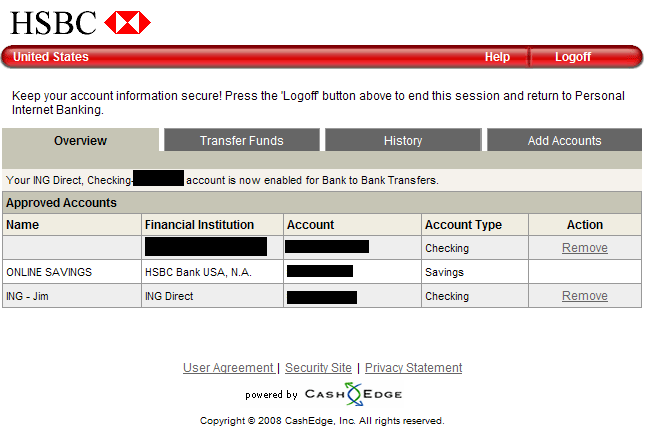
Well, I was curious as to whether HSBC would let me link up with ING Direct and they did! I submitted a request through the Bank to Bank Transfer online form, HSBC made two trial deposits to my ING Derect account, I verified the transaction and the link was created. It’s important to remember that Federal Reserve Regulation D limits the number of transactions on a savings account to six a month, so I just expended two in the verification process.
Quicken & Money Data Support
Quicken and MS Money data addicts users will be happy to know that HSBC Direct offers support for both applications (for Quicken, you get Windows and Mac version support).
Thoughts

Saving money should be fun and still be profitable. With the H.S.B.C. Direct Savings Account, that's exactly what you get. H.S.B.C. knows how hard you work for your money and want to help you save it and watch it grow. With economy as tough as it is today, it's not always as easy to save money as we'd like so H.S.B.C. wants to make it as easy for you as possible by offering you the H.S.B.C Direct Savings Account.
What's So Special About the H.S.B.C. Direct Savings Account
You'll love all the benefits that come with your H.S.B.C. Direct Savings Account. Unlike many savings accounts that require you to have a certain balance in your account at all times, H.S.B.C. Direct Savings Account has no minimum balance requirements. You will not have to pay one monthly fee after another, either. What you will get is an Annual Percentage Yield (APY) that's very competitive. You have your choice of bank and checking account that you want to connect your H.S.B.C. Direct account to. Your money is also FDIC-insured the highest possible amount.
H.S.B.C. makes it very easy to make deposits or withdrawals with your account. You'll love the convenience this account provides you with. You can also easily transfer money online back and forth from one account to another. Although you can view your statements online, you can also export your data into MS Money or Quicken or save and print them in PDF formats.
H.S.B.C. Direct Savings Account offers you some of the best and most convenient features without the many fees that are common with other banks. You will NOT be charged monthly fees, bank-to-bank transfer fees, bill payment fees, pre-authorized payment fees and ATM fees if you're using an ATM in the HSBC Network. Withdrawals and deposits can also be made from any HSBC Bank in Canada as well.
Easy Access to Your Account
One of the many things you'll love about the H.S.B.C. Direct Savings Accounts (besides all the benefits) is the easy access you'll have to your account. When you log onto the HSBC Direct site, you'll immediately see the link for you to access your account. The first page you'll see will be the Account Summary page, which tells you almost everything you need to know. The account information you'll see is current as of today. Unlike traditional checking accounts where you have to wait to get your monthly checks to verify your account, you can see up-to-date information every day! Some of the things you'll see on the Account Summary page include:
· Your current bank balance
· Your available balance
· Last statement date
· Interest year to date
· The last 9 transactions on your account
Setting up your new H.S.B.C. Direct Savings Account is fast and easy, so don't waste any more time getting all you can possibly get from your money. Shouldn't you get every possible benefit you can when you're able to save money? Every possible benefit is exactly what you'll get from H.S.B.C..
Bank of America, which has endured a number of problems since merging with Merrill Lynch last year, said its earnings after payment of preferred dividends were $2,42-billion in the second quarter – a fall on a year ago but still ahead of forecasts.
It said its results reflected a gain from selling part of its stake in China Construction Bank and, like Goldman Sachs and JPMorgan, said it had a handsome profit from its trading business.
Bank of America reported continuing losses from failed loans. It recorded a $13,4-billion provision for loan losses during the second quarter as consumers struggled with debt amid rising unemployment.
Citigroup reported a $4,3-billion second-quarter profit thanks to gains on its Smith Barney deal, although its primary banking businesses continue to suffer from rising credit losses.
The bank, propped up with $45-billion of taxpayers' money since markets imploded last autumn, recorded a $6,7-billion gain from merging Smith Barney into a brokerage venture with Morgan Stanley. Under accounting rules, Citi gets to mark up its entire stake in the venture, of which Morgan owns 51%.
Bank of America said its results also reflected a gain from selling part of its stake in China Construction Bank. The results included $713-million in dividend payments tied to a federal bailout and a charge to bolster a federal deposit insurance fund.
The company said its mortgage revenue rose after its acquisition of lender Countrywide Financial, reflecting the refinancing boom triggered by lower mortgage rates. - guardian.co.uk © Guardian News and Media 2009
The government has told Bank of America it needs $33.9 billion in capital to withstand any worsening of the economic downturn, according to an executive at the bank.
If the bank is unable to raise the capital cushion by selling assets or stock, it would have to rely on the government, which has provided $45 billion in capital through the Troubled Asset Relief Program.
It could satisfy regulators’ demands simply by converting non-voting preferred shares it gave the government in return for the capital, into common stock.
But that would make the government one of the bank’s largest shareholders.
Executives at the bank, one of the largest being examined, sparred with the government over the amount, which is higher than executives believed the bank needed.
But J. Steele Alphin, the bank’s chief administrative officer, said Bank of America would have plenty of options to raise the capital on its own before it would have to convert any of the taxpayer money into common stock.
“We’re not happy about it because it’s still a big number,” Mr. Alphin said. “We think it should be a bit less at the end of the day.”
The government’s determination that Bank of America doesn’t need as much capital as it has already received from taxpayers is an indication that even some of the most troubled banks may not need more government money than has been allocated to them.
The Treasury Department declined to comment on Tuesday evening.
Citigroup, by contrast, has already decided to allow the government to convert some of its investment into common stock.
Under the arrangement worked out between the Treasury and Citigroup earlier this year, the Treasury will receive mandatory convertible preferred shares, meaning preferred shares that can be converted to voting shares of common stock at the will of the government.
If Bank of America relied on that conversion for the majority of the capital it needs to maintain, the government would become one of the bank’s largest shareholders.
Regulators have told the banks that the common shares would bolster their “tangible common equity,” a measure of capital that places greater emphasis on the resources that a bank has at its disposal than the more traditional measure of “Tier 1” capital.
Citigroup, the largest and most deeply troubled of the banks, is expected to need to raise capital as insurance against any further downturn in the economy.
The government told the bank it would need $50 billion to $55 billion in capital, a requirement that would force it to raise $5 billion to $10 billion in new capital, according to people briefed on the final results.
Citigroup executives say the bank can easily cover any shortfall, and is considering several options to close that gap.
The Obama administration plans to publicize the results of stress tests on Thursday.
The results are expected to reveal that a number of them need additional capital, and many banks have negotiated with the government on what the actual capital requirements should be since they learned of the preliminary findings last week.
The tests are also expected to show that several banks, including Bank of New York Mellon, Goldman Sachs and JPMorgan Chase, are healthy enough to repay TARP funds.
Mr. Alphin noted that the $34 billion figure is well below the $45 billion in capital that the government has already allocated to the bank, although he said the bank has plenty of options to raise the capital on its own.
“There are several ways to deal with this,” Mr. Alphin said. “The company is very healthy.”
Bank executives estimate that the company will generate $30 billion a year in income, once a normal environment returns.
The company has faced criticism over its acquisition of Merrill Lynch, the troubled investment bank, and last week, shareholders voted to strip the bank’s chief executive, Kenneth D. Lewis, of his title as chairman of the board. The board said last week that it still unanimously supports Mr. Lewis in his role as chief executive.
Mr. Alphin said since the government figure is less than the $45 billion provided to Bank of America, the bank will now start looking at ways of repaying the $11 billion difference over time to the government.
In the case of Citigroup, which has also received two taxpayer lifelines, executives say the bank can easily cover any shortfall, and is considering several options to close that gap.
Among them are efforts to accelerate the sales of several businesses within Citi Holdings, a holding tank for assets it plans to shed, or to expand its common stock conversion plans to a broader base of private investors who hold Citigroup preferred stock. Both measures would avoid an increase in the government’s expected 36 percent ownership stake.
Taxpayer-supported Banks have been eager to wean themselves from the government’s purview, and many analysts have questioned how useful the stress tests will be in assessing their true health.
Also Tuesday, senior government officials said the Treasury Department is planning to require taxpayer-supported banks seeking to free themselves from the government’s grip to show that they can repay the lifelines without additional subsidies that have helped them survive the financial crisis.
Banks have had an indirect subsidy adopted by the government last fall that allows them to issue debt cheaply with the backing of the Federal Deposit Insurance Corporation.
The Treasury is expected to announce as early as Wednesday that healthier banks must show that they can issue debt without the guarantees before they are allowed to exit the Troubled Asset Relief Program, or TARP.
The banks also must demonstrate that they will be able to sell stock to private investors and pass a government stress test to show that they are healthy enough to survive without the taxpayer aid.
Fully capitalizing on the opportunities with the State’s measures to increase domestic demand and stimulate economic growth, BOC accelerated its pace in loans and deposits expansion and achieved rapid growth. As at 31 March 2009, the Bank’s domestic RMB-denominated loans increased by RMB 569.4 billion or 24% compared with the end of 2008 and the market share increased by 0.62 percentage point. Domestic RMB-denominated customer deposits also increased by RMB 723.1 billion or 18% from the end of 2008. Market share of the Bank’s domestic RMB-denominated corporate deposits and savings deposits also increased by 0.79 and 0.14 percentage point respectively, compared with the end of 2008.
In the mean time, BOC proactively adjusted its assets/liabilities structure, increased the proportion of high yield assets and lowered funding cost. The proportion of foreign currency-denominated assets of the group at the end of first quarter was reduced by 6 percentage points compared to the end of 2008 to 29%. RMB-denominated investment securities increased to RMB 1,219.482 billion, up by 18.29%, whilst the amount of foreign currency-denominated investment securities was reduced by 4.30% to USD 86.157 billion. Demand deposits represented 44.85% of the total customer deposits, an increase of 0.23 percentage point compared to the end of 2008. Loans account for 49.73% of the balance of interest-earning assets, up 0.43 percentage point. Loan to deposit ratio increased by 0.28 percentage point to 64.88%.
In the first quarter of 2009, net interest income amounted to RMB 36.838 billion, down 9.74% against the same period of 2008. Net interest margin was 2.14%, down by 63 basis points year-on-year, or 34 basis points from the fourth quarter of 2008.
In the first quarter, total export and import trade volume in China decreased by 24.9% year-on-year, but BOC’s international trade settlement volume still reached USD 137.862 billion and maintained its market share. Also, the Bank capitalized on the business opportunities arising from credit expansion and domestic consumption demands; financial advisory fee income increased by 70% year-on-year, and bank cards related fee income also rose by 21%. The bank achieved net fee and commission income of RMB 11.263 billion, a strong rebound of 38.95% compared to the fourth quarter of 2008, representing 22.32% of operating income, an increase of 1.84 percentage points compared with the same period of 2008.
While expanding business size and optimizing business structure, BOC further enhanced its cost management. Staff cost in the first quarter dropped by 3.79% year-on-year. Operating expense dropped by 15.07% year-on-year. Cost to income ratio decreased by 1.57 percentage points to 33.06%.
BOC continued to exercise stringent credit quality control, fortify its effort in non-performing loan recoveries, and strictly control the growth in non-performing loans. As a result, the Bank’s total identified impaired loans decreased by RMB3.652 billion from the end of 2008 to RMB 87.227 billion, with impaired loan ratio at 2.29%, a decrease of 0.47 percentage point from the end of 2008. The impaired loan coverage ratio reached 123.43%, up 6.25% from last year end. Non-performing loans amounted to RMB 85.127 billion, down by RMB 2.363 billion. Non-performing loan ratio dropped by 0.41% to 2.24%, and non-performing loan coverage ratio rose by 4.75 percentage points from the end of 2008 to 126.47%. Impairment losses on loans and advances for the first quarter were RMB 2.752 billion and credit cost was 0.31%.
As at 31 March 2009, the carrying value of US subprime mortgage related debt securities, US Alt-A mortgage-backed securities, Non-agency US mortgage-backed securities, debt securities issued by and mortgage-backed securities guaranteed by US Freddie Mac and Fannie Mae held by the Bank amounted to USD 13.145 billion, a decrease of USD 2.861 billion from the end of 2008. The aggregated amount of allowances for these securities was USD 4.838 billion, up by USD 0.378 billion. Impairment losses on investment securities for the quarter amounted to RMB 3.013 billion.
BOC has achieved a strong start in all business areas in the first quarter, providing a solid base for the healthy development of all businesses for the year. While the global economic environment gradually stabilized and China’s economy showed early signs of recovery, BOC will seize the business opportunity with the Chinese macro-economic policy of “expanding domestic demand, adjusting economic structure and achieving economic growth”, and continue to implement its strategy of “expand business size, optimize business structure, develop premium brand, strengthen infrastructure, control cost and sharpen competitiveness”. BOC will focus on increasing market share and expanding customer base through product and service innovation, and continue to restructure the Bank’s service and growth mode, as well as accelerating the expansion of overseas business, thereby fully implementing the strategic development plan.


